
Porcelain slabs and sintered stone
The terms sintered slabs and porcelain slabs are often used interchangeably, but there are some technical distinctions. Here’s a breakdown of their similarities and differences:
Similarities
Applications: Commonly used for benchtops, flooring, wall cladding, facades, and furniture.
Composition: Both are made from natural materials like clay, feldspar, silica, and mineral oxides.
Production Method: Both undergo sintering which is a process involving high pressure and very high temperatures to bond particles without melting them.
Properties:
- Very hard and dense
- Scratch-resistant
- UV, stain, and heat-resistant
- Low water absorption (typically <0.5%)
Differences
| Feature | Porcelain Slabs | Sintered Stone Slabs |
|---|---|---|
| Terminology | Ceramic material made using the porcelain process. | Broad term for any material produced via sintering. |
| Binders/Additives | Purely ceramic, with few or no polymer resins. | May include minerals not used in traditional porcelain (like quartz), sometimes different pigments or processes. |
| Branding/Market | Traditional tile industry. | Often marketed as “next-gen surfaces” in the engineered stone space. |
| Strength/Thickness Options | Typically 6–20 mm. | Available in more varied thicknesses, including very thin (3 mm) to thick (30 mm+). |
| Finish Options | Matte, polished, structured (depending on manufacturer). | More advanced surface textures like leathered, ultra-matte, metallic, etc. |
| Cost | Usually slightly less expensive. | Tends to be more premium-priced. |
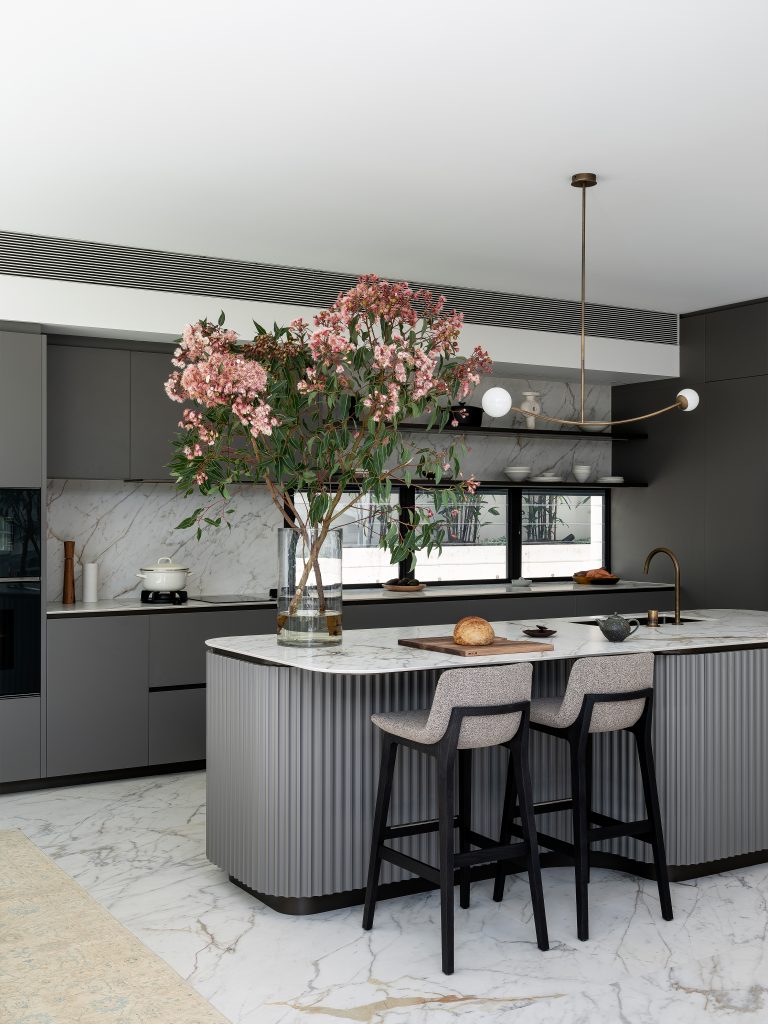
Porcelain slabs are a type of sintered surface, but not all sintered surfaces are porcelain. Sintered slabs is a broader category and may use proprietary formulas or extended mineral blends for enhanced performance. In practical use, both perform similarly, but sintered stone is often marketed as a premium product with more branding and innovation in finishes.
Porcelain Slabs
Porcelain slabs bring together cutting-edge manufacturing and timeless style, making them one of the most versatile surfaces available today. Produced from carefully selected clays and minerals, they are kiln-fired at over 1200°C, resulting in a product with outstanding density, hardness, and resilience.
- Large-Format Elegance: Available in slab sizes of up to 3.2m x 1.6m, porcelain reduces the need for grout joints, creating a smooth, continuous finish that enhances both residential and commercial design projects.
- Technical Performance: With a water absorption rate below 0.5%, porcelain resists moisture penetration, preventing stains and protecting against mould or bacterial growth. This makes it ideal for kitchens, bathrooms, and high-use environments.
- Slip Resistance & Safety: Porcelain slabs are tested under AS 4586:2013 to ensure compliance with Australian slip resistance standards. Available finishes achieve ratings from P2 for dry indoor areas to P5 for outdoor and wet environments, offering peace of mind in both residential and commercial applications.
- Strength & Longevity: Resistant to scratches, household chemicals, and UV exposure, porcelain slabs maintain their finish and colour even in outdoor settings.
- Ease of Maintenance: Their non-porous surface requires no sealing and is easy to clean, delivering low-maintenance practicality without compromising on appearance.
- Design Versatility: Offered in a wide variety of looks — from natural stone and concrete aesthetics to sleek minimalist finishes — porcelain adapts effortlessly to different styles and applications.
Whether installed as a flooring solution, wall cladding, benchtop, or façade, porcelain slabs deliver a refined, architectural quality while offering the technical resilience needed for everyday use.
Sintered Stone
Sintered stone is the pinnacle of modern surface innovation, designed to perform under the most demanding conditions while offering the elegance of natural stone. Using advanced technology, mineral particles are compacted under immense pressure and heat (over 1200°C) to form an ultra-compact, resin-free surface that is both beautiful and virtually indestructible.
- Engineered for Excellence: The sintering process recreates the metamorphic changes that occur naturally over thousands of years, but in a matter of hours. The result is a fully dense, zero-porosity surface that resists staining, moisture, and bacterial growth.
- Unrivalled Durability: Sintered stone is highly resistant to scratches, abrasion, UV rays, and thermal shock. Hot pans, sharp utensils, and exposure to sunlight will not compromise its surface, making it perfect for both interior and exterior use.
- Safety Underfoot: Textured finishes are tested to AS 4586:2013 and achieve up to P5 and R12 slip resistance ratings, making sintered stone an excellent choice for wet areas such as bathrooms, pool surrounds, or commercial kitchens.
- Versatility in Application: Available in multiple thicknesses such as ultra-slim 6mm panels for wall cladding to robust 20mm slabs for benchtops and floors — sintered stone adapts to a wide range of residential and commercial uses.
- Low Maintenance Living: Its dense, non-porous structure means it does not require sealing or special cleaners. A simple wipe is enough to keep it looking pristine.
- Sustainability Benefits: Made entirely from natural minerals, sintered stone is free from resins and chemicals and is fully recyclable, aligning with environmentally conscious design practices.
Sintered stone offers timeless design freedom with cutting-edge performance, whether used for a sophisticated kitchen benchtop, a durable outdoor surface, or a striking façade. It’s a premium choice for homeowners, designers, and builders seeking a material that balances luxury aesthetics with unmatched durability.
DISCLAIMER All material on this website is published in good faith, however Skheme Pty Ltd does not warrant or represent the origin, validity, accuracy, completeness, timeliness, authenticity or reliability of, nor accept any responsibility for errors or omissions, in any material on this website or in any accompanying or other material, including advertisements, whether oral, visual, written, printed or electronic. Skheme Pty Ltd is not liable for any losses, claims, damages, demands, costs and expenses of whatsoever nature arising in any way, including those caused by negligence, out of or in connection with the use of this website, or any accompanying or subsequent information, or by reason of any reliance upon its contents by any person, company or organisation. All access to, and use of, the information is at the user’s risk. All technical details, recommendations and other information contained on this website represent the best of our knowledge and experience at the time of publishment. It is your responsibility to ensure that our products are used and handled correctly and in accordance with any applicable Australian Standard, our instructions and recommendations and only for the uses they are intended. Country specific recommendations, depending on local standards, codes of practice, building regulations or industry guidelines, may affect specific installation recommendations. The supply of our products & services is also subject to certain terms, warranties and exclusions, which may have already been disclosed to you in prior dealings or are otherwise available to you on request. Skheme reserves the right to alter, amend, vary or otherwise change any information on this website at any time and without prior notice to you to reflect our ongoing research and development program. The provision of any URL or link is done for the convenience of users of this website. It does not constitute an endorsement by the Skheme of that URL or link or the information at that Internet site. Potential customers should speak to a Skheme consultant regarding the qualities, colours and textures of all Skheme products before purchase.